Download Contemporary Education in India Handwritten Notes PDF

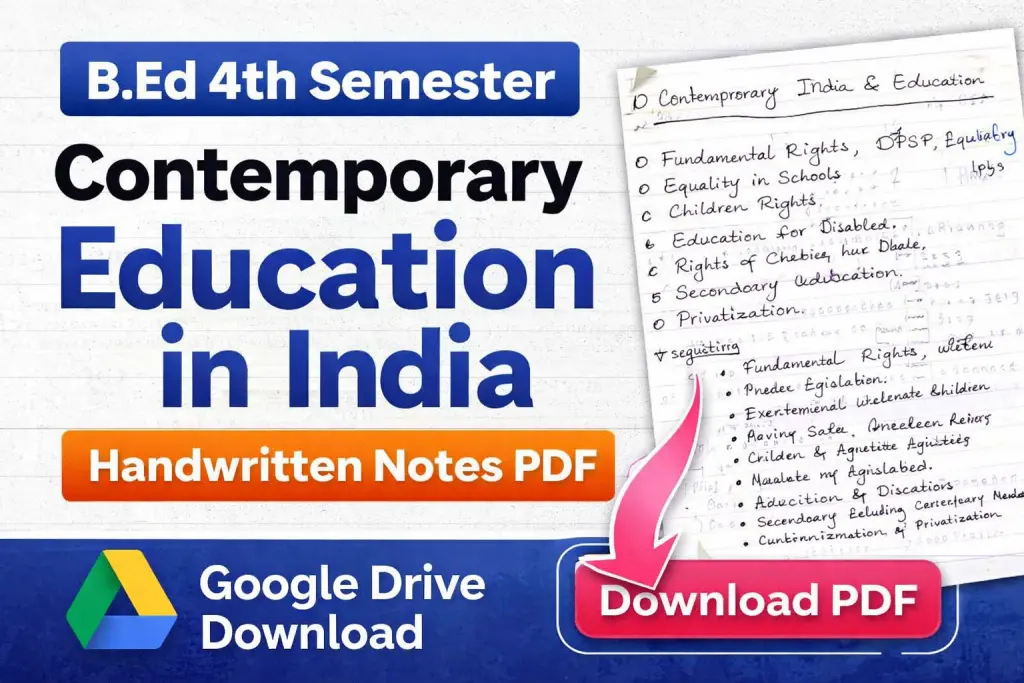
Download Contemporary Education in India B.Ed 4th Semester handwritten notes PDF. Useful study material covering Fundamental Rights, DPSP, Educational Inequality, Children Rights, Secondary Education and more for B.Ed students.
Contemporary education in India focuses on the relationship between education, society, democracy, and social justice. The Indian education system is influenced by the Constitution of India, which guarantees equality, freedom, and opportunities for every citizen. Education plays an important role in developing responsible citizens and building a democratic society.
This subject helps B.Ed students understand educational policies, social issues in education, and the importance of equal educational opportunities.
Download Contemporary Education in India Handwritten Notes PDF
B.Ed students who are looking for Contemporary Education in India handwritten notes can download the complete study material from the direct Google Drive link given below. These notes are specially useful for B.Ed 4th Semester students preparing for exams or assignments.
📥 Download Handwritten PDF:
Click the Google Drive link below to download the full handwritten notes in PDF format.
This handwritten PDF covers many important topics of Contemporary India and Education, including:
- Basic Features of the Constitution of India
- Fundamental Rights
- Directive Principles of State Policy (DPSP)
- Federal Structure of India
- Human Rights and Classification
- Rights of Children
- Child Labour and Issues Affecting Children’s Education
- Street Children, Orphans and Abandoned Children
- Differently Abled Children and Inclusive Education
- Corporal Punishment in Schools
- Equality of Educational Opportunities
- Inequality in Schooling (Public vs Private Schools)
- Rural and Urban School Differences
- Mass and Elite Schools
- Universalization of Education
- Universal Access, Enrolment and Retention
- Secondary Education and its Aims
- Privatization of Education
- Vocationalization of Education
These handwritten notes are easy to understand and very helpful for B.Ed exam preparation.
👉 Scroll down and click the Download PDF button to get the file directly from Google Drive.
1. Basic Features of the Constitution of India
The Constitution of India is the longest written constitution in the world. It defines the structure, powers, and responsibilities of the government and guarantees the rights of citizens.
According to the notes, the constitution includes three important elements:
- Fundamental Rights
- Directive Principles of State Policy
- Federal Structure Contemporary Education and Indi…
These elements ensure democratic governance and protect citizens’ rights.
Contemporary Education in India – B.Ed 4th Semester Handwritten Notes PDF Download
2. Fundamental Rights
Fundamental Rights are essential for the development of every individual and for maintaining human dignity. These rights are guaranteed to all citizens by the Constitution.
Major Fundamental Rights include:
Right to Equality
Ensures equality before the law and prohibits discrimination based on religion, caste, sex, or place of birth.
Right to Freedom
Provides freedom of speech, expression, movement, and occupation.
Right Against Exploitation
Protects citizens from human trafficking and child labor.
Right to Freedom of Religion
Allows individuals to practice and propagate their religion freely.
Cultural and Educational Rights
Protects the rights of minorities to establish and manage educational institutions.
Right to Constitutional Remedies
Allows citizens to approach courts if their fundamental rights are violated. Contemporary Education and Indi…
These rights create a democratic environment and support equal educational opportunities.
3. Directive Principles of State Policy (DPSP)
Directive Principles are guidelines for the government while making laws and policies. They aim to create social and economic justice in society.
Important features:
- Mentioned in Articles 36–51
- Non-justiciable in nature
- Help establish a welfare state
Types of Directive Principles:
- Socio-economic principles
- Gandhian principles
- Liberal principles Contemporary Education and Indi…
These principles encourage the government to improve public health, education, and living standards.
4. Human Rights and Their Classification
Human rights are basic rights inherent to all human beings regardless of nationality, gender, or religion.
Characteristics of human rights:
- Universal
- Essential for human dignity
- Inalienable and irrevocable Contemporary Education and Indi…
Types of human rights include:
- Civil rights
- Political rights
- Social rights
- Cultural rights
- Economic rights
Education helps people understand and exercise these rights effectively.
5. Rights of Children
Children have special rights because they require protection and care for their development.
Major rights of children include:
Right to Survival
Includes the right to life, health care, and proper nutrition.
Right to Protection
Protects children from abuse, exploitation, and dangerous work.
Right to Participation
Allows children to express opinions and participate in decisions affecting them.
Right to Development
Includes education, recreation, and mental development. Contemporary Education and Indi…
Protecting children’s rights ensures a strong foundation for a healthy society.
6. Issues Affecting Children’s Education
Several social problems affect children’s access to education:
Child Labour
Child labour deprives children of education and harms their physical and mental development.
Street Children
Children living on streets often lack access to education, healthcare, and safety.
Abandoned Children and Orphans
These children require special care, adoption support, and social protection. Contemporary Education and Indi…
The government and society must work together to eliminate these problems.
7. Education for Differently Abled Children
Differently abled children face many challenges in accessing education.
Types of disabilities include:
- Blindness
- Low vision
- Hearing impairment
- Locomotor disability
- Mental retardation
Education policies focus on inclusive education, where children with disabilities learn together with other students. Contemporary Education and Indi…
Inclusive education promotes equality and social integration.
8. Inequality in Schooling
Educational inequality still exists in India.
Major forms include:
Public vs Private Schools
Private schools usually have better facilities and resources compared to government schools.
Rural vs Urban Schools
Urban schools often have more infrastructure and teaching resources than rural schools.
Mass vs Elite Schools
Elite schools cater mainly to wealthy families, while poor students have limited access to quality education. Contemporary Education and Indi…
Reducing these inequalities is essential for achieving educational justice.
9. Universalization of Education
Universal education aims to ensure that every child receives basic education.
It includes three main aspects:
- Universal Access – All children should have access to schools.
- Universal Enrolment – All children aged 6–14 must be enrolled in school.
- Universal Retention – Students should continue education until completion of primary school. Contemporary Education and Indi…
Government programs such as mid-day meals, free textbooks, and uniforms help achieve this goal.
10. Secondary Education and Its Aims
Secondary education (Classes IX–XII) plays an important role in shaping students’ future.
Aims of secondary education include:
- Overall personality development
- Promotion of social values and citizenship
- Development of practical and vocational skills
- Preparation for higher education and employment Contemporary Education and Indi…
It bridges the gap between primary education and higher education.
11. Privatization and Vocationalization of Education
Privatization of Education
Privatization refers to the transfer of education management from government to private organizations.
Importance:
- Improves educational quality
- Encourages technological advancement
- Expands educational facilities in urban and rural areas Contemporary Education and Indi…
Vocationalization of Education
Vocational education focuses on practical skills for employment.
Benefits:
- Improves employability
- Provides alternatives to traditional higher education
- Supports economic development Contemporary Education and Indi…
Conclusion
Contemporary education in India aims to build an inclusive, democratic, and equitable society. Understanding constitutional values, human rights, educational equality, and inclusive education helps teachers create a better learning environment.
For B.Ed students, studying these topics is essential because teachers play a key role in shaping the future of society through education.
Download PDF – Click Here